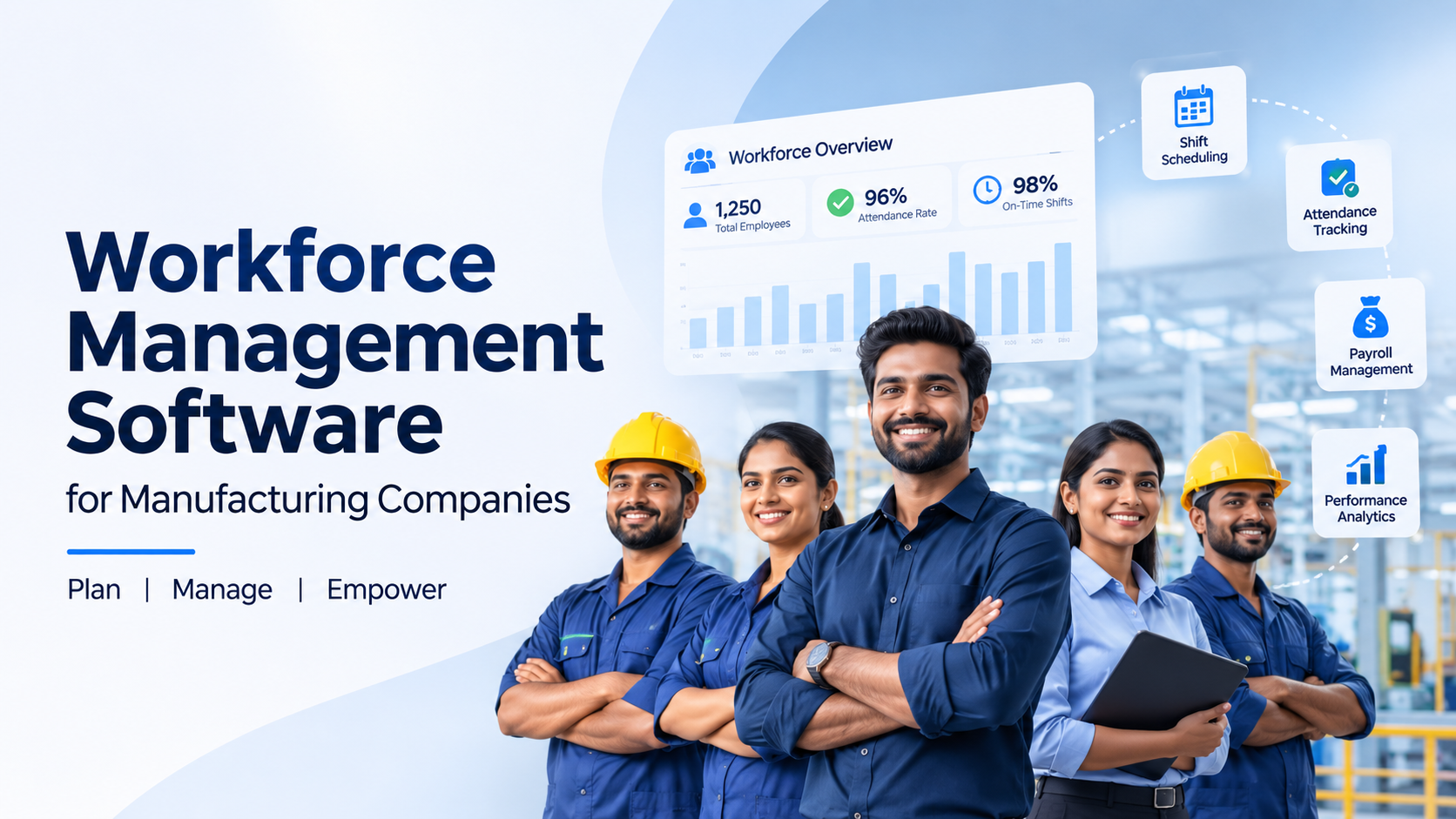
Workforce management software creates shift rosters, recognises staff presence and works out pay. Manufacturers in India face added complexity as there are often shift rotations, staff numbers fluctuate depending on orders and permanent and contracted staff are both used. Labour legislation has also recently changed significantly with the introduction of labour codes. Here we set out basics, explain how workforce management software works and analyse in detail 10 workforce management software solutions. As Voyon Folks is our own product we also include it within this analysis applying the same principles as for others.
What workforce management software does on the factory floor
Like a factory, a working rota must be created for each hour of the day. Workforce management software then recognises presence (via for example biometrics or hand-held time clocks), adds on overtime and applies shift rules. These ‘clean’ hours are passed onto payroll. An additional labor management system analyses labour hours and productivity, so that managers can judge if a production line has the right number of staff for the task in hand. Whilst workforce management software brings benefits – reducing argument, curbing unauthorised overtime and speeding up payroll – there is also work involved to set up the software, prepare data and train staff. Poorly adapted software, for example, is often avoided as it does not match shift requirements.
These are frequently conflated. Workforce management software relates to the people aspect of a business and typically includes rostering, presence, leave and payroll functions. A labor management system assesses and monitors labour productivity and links this to output. Manufacturing operations management software (often known as MES or as part of an ERP) manages the actual manufacturing process, looking at for example orders, machinery, material and quality. Most manufacturers require workforce management software, will benefit from a labor management system and already have manufacturing operations management software in place. It is important therefore to assess how well your HR solution integrates with these other areas since staff resource is influenced by production requirements.
HR for manufacturing and human resources in manufacturing: what makes it different
HR for manufacturing is not merely HR for a business with a larger staff complement. Shift rotations are frequently used, along with night and overtime working. Presence data must also be secure. Furthermore, significant numbers of staff may be contracted in. Human resources in manufacturing can also cover numerous locations and each will be subject to differing legislation. Often the HR manufacturing function for small manufacturers has to manage the requirements for several shifts simultaneously. Additionally, where shift rotation, mandated overtime and contractor registers are all relevant on the same day, an HR solution effective for an office environment will often prove inadequate.
How we shortlisted these ten
We assessed solutions for suitability for HR manufacturing and shift-working environments. We analysed functionality including staff presence and rostering, overtime and statutory payroll. Mobile device functionality for line staff was also considered, as was the level of an organisation’s AI usage. Information was gained from providers’ websites and public comparison resources. Below is therefore a summary of what the suppliers state about their solutions. Independent testing has not been carried out. Note that this is not a ranked list. Selection should be made according to your business’ scale, location and current systems. Always validate functionality during a live demonstration, adapting to your shift requirements.
The 10 best workforce management software
1. Voyon Folks
A lifecycle HRMS incorporating AI, Voyon Folks operates in India, Dubai, Singapore and Ireland and has clients throughout the GCC, APAC and India. It is appropriate for businesses with several legal entities and differing business unit policies and employing up to tens of thousands of staff.
Functionality: Leave and workflow; integration with biometric devices; AI, to analyse presence, and to regularise and manage shifts; and the Folksy mobile AI assistant for leave and balance checks. Solutions are available as SaaS or on-premise.
Benefits and issues: Well-suited to multi-legal entity manufacturers. As Voyon Folks does not include manufacturing planning or MES functionality, it should be integrated with your manufacturing operations management software where staff resource is affected by production requirements.
2. Darwinbox
This cloud-hosted HCM solution is geared towards extensive dispersed workforces. It emphasises flexible plant shift settings, automated overtime calculation, mobile line staff functionality and multinational payroll. An AI component, named Sense, is also included.
Functionality: Multi-entity rostering; shift working; mobile presence and pay slip functionality; and statutory payroll deductions.
Benefits and issues: Particularly appropriate for medium and large multi-national businesses. However, smaller manufacturing plants may find functionality excessive. There is also some set-up work required.
3. Keka
Popular within India, Keka also has a special manufacturing solution. Suppliers describe its functionality as enabling easy shift rostering, real-time synchronisation with over 200 biometric devices, automatic overtime and additional shift calculation and integrated payroll.
Functionality: Rostering; biometric integration; overtime calculation; mobile presence via selfies and leave approvals.
Benefits and issues: Highly regarded for ease of use. Well-suited to medium sized companies. However, for extremely large or highly complex multinational businesses, it is advisable to assess the solution’s depth in relation to your policies.
4. greytHR
Originally a payroll solution, greytHR now provides end-to-end HR functionality. Presence can be recognised via biometric devices and mobile hand-held time clocks with geolocation. Other functionality includes shift rostering, overtime calculation and payroll, incorporating statutory PF, ESI, professional tax and LWF deductions.
Functionality: Biometric and geo-location presence; leave policies; statutory payroll; and an AI assistant.
Benefits and issues: Particularly strong in payroll and statutory areas. Well liked by SMEs. However, for manufacturing businesses with highly dynamic and often changing multi-shift working, assessment should be made of the depth of rostering functionality. Some comparison resources highlight this as an area requiring attention.
5. Zimyo
Zimyo promotes itself as being suitable for factories and line staff. Staff presence (via both biometric and geo-located mobile clocks) is passed to payroll. Overtime is automatically calculated and statutory deductions are also automated.
Functionality: Shift and rostering, including shift rotations and night working; mobile shift swapping; secure presence functionality; and a staff mobile application for viewing pay slips and leave.
Benefits and issues: Well-suited to shift intensive businesses and for supporting mobile line working. Ensure that analytics and enterprise reporting functionality is adequate, particularly for large multi-plant businesses.
6. ZingHR
Often suggested for extensive operational workforces, ZingHR includes functionality for shift rostering, geo-location presence, contractor staff management and compliance, and is targeted at industrial businesses.
Functionality: Staff rostering; biometric kiosks; contractor management; and compliance reporting.
Benefits and issues: Well-suited to HR manufacturing for line staff set up. However, reviewers have noted that the interface and reporting can be quite complex. Training should therefore be provided.
7. factoHR
As well as presence, payroll and operations, factoHR also includes biometric and GPS presence functionality. It is often cited as being well-suited to medium and large shift intensive manufacturing businesses.
Functionality: Multi-channel presence; rostering; overtime; payroll; and expense claims.
Benefits and issues: Cost-effective for expanding manufacturers. Larger, multinational businesses are generally better supported by more extensive enterprise solutions.
8. UKG
Often seen as the gold standard in manufacturing scheduling software for shift working industries, UKG ensures that staff resource is aligned to production requirements and enforces labour legislation across different regions.
Functionality: Sophisticated rostering; shift differential pay; overtime prediction; and multi-plant 24/7 working planning.
Benefits and issues: Offers highly developed workforce management functionality. However, set-up can be time consuming. Furthermore, although localisation to the Asia Pacific region is available, this is not as well developed as in North America and Europe. Therefore, carefully ascertain the extent of Indian statutory functionality.
9. SAP SuccessFactors
Manufacturers already using SAP ERP will find that SAP SuccessFactors integrates HR with financials and operations.
Functionality: SAP finance-integrated payroll; multi-national compliance; and headcount planning linked to supply chain data.
Benefits and issues: Particularly relevant where uniformity is important between a business’ operations and HR data. Again, set-up can be time-consuming and the cost is high. Furthermore, whilst lightweight, native shift rostering is not as sophisticated as that offered by specialist solutions.
10. Oracle HCM Cloud
Oracle HCM Cloud unifies HR, talent and workforce planning and works with Oracle’s finance and supply chain solutions.
Functionality: Workforce planning modelling; plant-specific succession planning; and multi-national payroll and compliance.
Benefits and issues: Especially appropriate for large businesses within the Oracle environment. It is highly integrated with the Oracle stack and generally requires specialised IT and partner support.
Our Manufacturing Clients
Alongside hundreds of well-known brands, Voyon Folks has manufacturing clients in the GCC, APAC and India. Details for the five listed below are drawn from publicly available company information. The sections which follow illustrate how Voyon Folks meets the workforce management needs of these manufacturers. They do not present performance data.
YTY Group
Overview: Established in 1988 and based in Kuala Lumpur, Malaysia, YTY Group is a manufacturer of single-use medical examination gloves. It also has manufacturing plants in Malaysia and Indonesia.
Industry: Healthcare personal protection goods.
How Voyon Folks meets client’s workforce management needs: As a multi-plant, high volume manufacturer, precise staff presence information, overtime and multi-legal entity policy functionality are all important. Voyon Folks enables biometric presence recognition, rostering and leave management.
NeST Group
Overview: Based in Kochi, NeST Group was established in 1991 in the Cochin Special Economic Zone. Its core business, SFO Technologies, offers electronics manufacturing and engineering services to a range of industry sectors such as aerospace and defence, communications, energy, healthcare and transport.
Industry: Electronic manufacturing and engineering services.
How Voyon Folks meets client’s workforce management needs: With staff in both engineering and manufacturing in a number of locations, uniform policies are essential. Voyon Folks facilitates multi-legal entity and multi-location policy, leave and presence functionality and approvals.
Wipro Enterprises
Overview: Comprising two business divisions, Wipro Enterprises is the non-IT arm of the Wipro group. These are: Wipro Consumer Care and Lighting, which specialises in personal and home care and also manufactures lighting and furniture; and Wipro Infrastructure Engineering, which is a hydraulic goods manufacturer.
Industry: Consumer and industrial engineering goods manufacturing.
How Voyon Folks meets client’s workforce management needs: Large manufacturing plants and differing business unit policies are well-supported by Voyon Folks. Routine presence exceptions can also be automated. Customisable policies are available and AI agents are incorporated to analyse presence and manage shifts. Mobile access is also available, and can be personalised depending on user role.
DentCare
Overview: Founded by John Kuriakose in 1988, DentCare Dental Lab Pvt Ltd is based in Muvattupuzha, Kerala. It is a manufacturer of dental prosthetics and has clients in several nations.
Industry: Dental laboratory and medical goods.
How Voyon Folks meets client’s workforce management needs: Within a manufacturing environment which is largely staffed by technicians, secure presence information, and staff training and leave data are all important.
what to test before you buy
Other than a calendar, manufacturing scheduling software must address further aspects. During a live product demonstration, assess the following in any manufacturing scheduling software, reflecting your specific requirements:
- Shift working – including rotations, night working and part-time working. Also consider shift swapping and ad-hoc shift alterations.
- Overtime – including daily and weekly maximums, rounding and pre-approval for overtime working.
- Presence – using biometric, facial and/or hand-held time clock recognition. Offline presence functionality should also be available.
- Contractor staff – including the maintenance of and register for outsourced staff.
- Integration with payroll – so that hours, entitlements and deductions can be automatically transferred.
- Manufacturing operations management software integration – with for example your ERP, MES and/or production planning data.
Compliance for HR manufacturing teams in India
India’s four labour codes were notified on 21 November 2025. Final rules for these were notified by the Centre on 8 May 2026. Central sphere entities are predominantly covered by central sphere labour law. For the majority of private sector manufacturing plants, however, state labour law is applicable. At the time the central sphere labour law was notified, many states were still in the process of finalising their own labour law. Establish which legislation applies to human resources in manufacturing at each plant. Of particular relevance for workforce management software and HR for manufacturing:
- Maximum working hours – normally 8 hours per day and 48 hours per week.
- Overtime – should be paid at double the usual rate. Fractional hour rounding procedures apply. Staff should also agree to overtime working.
- Staff, pay, overtime and presence records – which may be maintained electronically.
- Contractor labour – primary employers share accountability for contractor staff behaviour. Contractors may also possess multi-state labour law licences.
- Payroll deductions – PF, ESI, professional tax and labour welfare fund continue to be deducted via payroll.
Good compliance minimises sanctions and arguments. However, continual assessment is necessary to ensure that legislative changes are understood at each manufacturing location. Software which effectively recognises presence and applies local overtime law will help here. Obtain individual legal advice regarding your set-up.
Where AI fits in workforce management software
There is increasing interest in AI enabled HRMS, AI HR and payroll, smart workforce management software and AI driven HR. Buyers wish for solutions which analyse as well as store data, especially in HR for manufacturing. Further terminology that is frequently encountered includes super AI, super intelligence and superintelligence AI. This refers to a future (as yet hypothetical) where machines become more intelligent than humans. Currently, however, no human resources in manufacturing processes operate in this manner. Presently, manufacturing can utilise limited artificial intelligence. This can be used, for example, to highlight absent presence data, advise on shift changes in manufacturing scheduling software and answer policy queries. Exceptions can also be directed. Nevertheless, human oversight is still essential, particularly for elements which affect pay.
How to choose the right workforce management software
Initially, analyse your HR for manufacturing parameters such as the number of manufacturing plants, the complexity of shift working, the level of contractor labour and your ERP system. From your shortlisted three or four solutions, implement one in one manufacturing plant. Evaluate its performance in terms of data inaccuracies, overtime correctness and payroll outputs. Gradually extend implementation across your manufacturing plants. Train managers and HR manufacturing staff, and regularly (every quarter for example) analyse exception reports.
Choosing infrastructure, not just software
As payroll accuracy, compliance and staff resource are all affected by workforce data, this is an infrastructure decision for human resources in manufacturing. Consider the benefits and challenges of differing workforce management software and labor management system solutions for your business scale and appetite for risk. Voyon Folks is designed for multi-legal entity businesses with diverse policies and large staff numbers. Furthermore, AI is incorporated into employee, manager and HR processes. For an example of how an AI enabled HRMS can manage presence, shifts and payroll, please visit www.voyonfolks.com.