


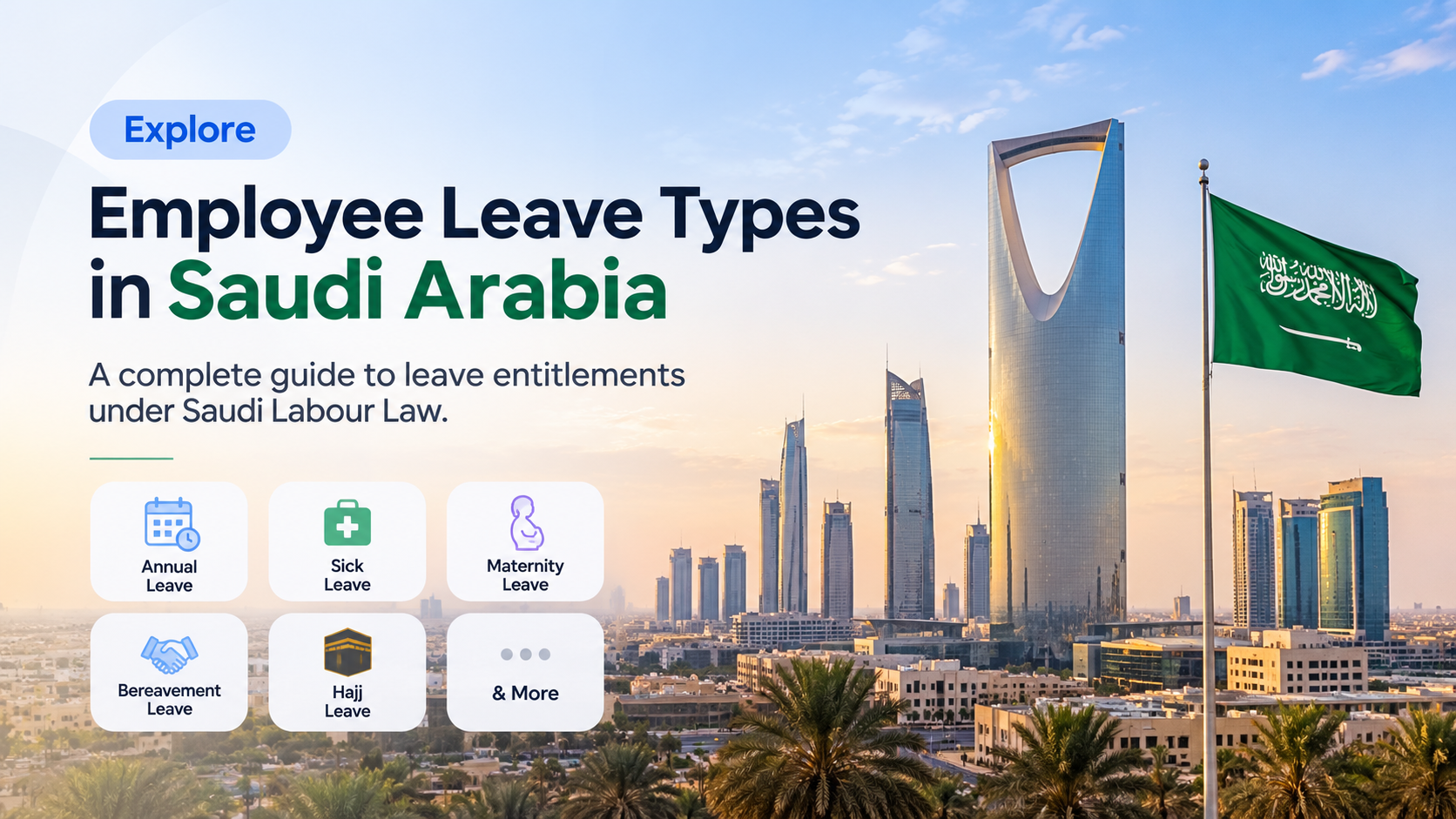
Despite the fact that regulations are frequently now changing, many employers continue to operate based on outdated handbooks and an untrusted spreadsheet. Whilst this was okay when regulation changes were infrequent, it is not appropriate now. Following the 2025 amendment to the Saudi Labor Law, there have been changes to a range of leave areas including maternity, paternity and bereavement. Having an out-of-date maternity leave entitlement or failing to recognise siblings' bereavement for example, is therefore no longer suitable. This is why employee leave types in Saudi Arabia, and the Saudi Labor Act behind them, need a fresh look.
As well as being an important area for staff, Saudi employee leave also has financial implications. Annual leave is pre-paid. Sick leave in Saudi arabia is paid in stages. Some leave types are also fixed in length and timing. An incorrect setup can result in unwarranted leave payments or payroll issues. After outlining the fundamentals, this guide explores each type of leave and its benefits and drawbacks. It then continues to explore how to manage leave in a compliant manner – without using spreadsheets. It covers employee leave types and policies from the fundamentals to compliance.
What Is Leave Under the Saudi Labor Law (Labor Act)? The Basics
Saudi Labor Law (sometimes referred to as Saudi Labor Act) is the primary private sector employment regulation in the Kingdom. It establishes minimum leave entitlements; employers can provide greater benefits than those specified in the law. The 2025 amendment made changes to numerous labor law articles. As there has not been a fresh labor law introduced in 2026, the 2025 changes currently stand.
Labor Law leave includes fully paid annual and sick leave (the first stage), maternity, marriage and bereavement leave. Semi-paid sick leave is also included. Finally, unpaid leave is granted for mutual agreed additional leave. Differentiation is important as the impact of each leave type varies for payroll and end of service calculations. These are the common types of employee leave in the Kingdom.
Annual Leave in Saudi Arabia: Entitlement, Payment and Rules
This is the most widely used form of leave. Under article 109, and employee is eligible for a minimum of 21 days paid annual leave, increasing to a minimum of 30 days after a continuous period of 5 years with one employer. Note that service is calculated with one employer only – so a change of employer will reset service. Annual leave is pre-paid and cannot be waived or converted into cash by employees during their period of employment. Should an employee leave before they have used their leave, then this is paid out.
Benefits include transparent minimum entitlements and good planning. Staff can also rest effectively. However, pre-payment influences cash flow. Moreover, accumulated leave forms a company debt. Furthermore, there can be misunderstanding around the law's reference to calendar days, when in practice most workplaces operate on a common day out of the week basis. Ensure that you understand the current guidance on this area and then set up your system accordingly.
Sick Leave, Illness Leave and Sick Day Leave
Labor Law refers to this as sick leave. Employers may also refer to it as illness leave or sick day leave. Whether it is called sick leave, illness leave or sick day leave, the same rules apply. An employee can take sick leave for up to 120 days in a year from the initial day of sickness. Sick leave is paid as follows:
- Days 1-30: Full salary
- Days 31-90: Three quarters salary
- Days 91-120: Unpaid
Note that the 120 days relate to a yearly entitlement so that multiple sickness episodes will all share the same leave allowance. Generally, a medical certificate is required. There are also specific regulations relating to occupational injuries.
Benefits of this leave type include staff receiving income support during sickness. Furthermore, the staged payment is easily explained. Nevertheless, manual calculation of staged sick pay can be prone to error. As the sick leave entitlement is shared for the year, it can also be challenging to monitor for several sickness events. Additionally, employers must plan for and verify medical certificates where staff are absent for an extended or regular period.
Maternity Leave, Pregnancy Leave and Paternity Leave
Under article 151, the 2025 amendment increased the maternity leave entitlement to 12 fully paid weeks with no service requirement. Six weeks post-birth are compulsory. An employee is free to decide how to use the remaining 6 weeks. She can even begin her maternity leave up to 4 weeks prior to her due date. This pre-due period is commonly known as 'pregnancy leave.' Pregnancy leave is part of maternity leave, so set up both together. Please note that this is not a distinct leave category but is in fact part of maternity leave. In addition, a female employee may extend her maternity leave by one unpaid month or two if the child is born with poor health or a disability.
Employers grant 3 fully paid days of paternity leave (under article 113) which must be taken within 7 days of a birth (as stipulated by the 2025 amendment).
Benefits of these leave entitlements are that full salary is provided and there is a clear framework which can aid staff retention and avoid contention. However, the employer incurs all costs. The mandatory 6-week period cannot be reduced. Twelve week planning is also required. Ensure that your leave and payroll arrangements reflect the amended regulations.
Bereavement Leave and Compassionate Leave
Labor Law describes this leave type as bereavement leave in saudi arabia. Employers may also use the expression compassionate leave. Employees are eligible for fully paid leave for family member deaths under article 113 (amended in 2025):
- Spouse, parent/ascendant or child/descendant: 5 days
- Brother/sister: 3 days (new in 2025)
Although the law does not specify a compassionate leave category, employers can choose to provide further leave for, for example, travelling overseas for a funeral. In addition to bereavement leave, a Muslim female is entitled to 130 days unpaid iddah leave (under article 160) should her husband pass away. Non-Muslim females receive 15 days of this leave.
Benefits of this leave are that employees are able to deal with loss without financial concerns. Yet, the statutory duration may seem insufficient particularly if travel is required. Further, you may wish to develop a written policy to clarify family relations.
Other Common Types of Employee Leave: Marriage, Hajj, Exam and Unpaid Leave
These are some of the common types of employee leave. Other leave types are briefer and more particular:
- Marriage: 5 fully paid days for an employee's marriage (article 113).
- Hajj: 10-15 days, which can only be taken once in an employee's service and after 2 years' service with an employer (article 114). Employers can control the number of employees who take this leave in a year.
- Exam: On the day of an exam, employees who are undergoing training approved by their employer receive paid leave. However, this is only for the first time they sit an exam. Should an employee retake an exam, then they receive unpaid leave (article 115).
- Unpaid: This can be for any length of time and is subject to employer agreement (article 116). Should an employee take more than 20 days of unpaid leave, then unless both parties agree otherwise, their employment contract is effectively put on hold. During this time, the employee does not gain end of service benefits.
Although good at providing flexibility, employers should maintain a written record of their employees' unpaid leave authorisations. Frequently, end of service disagreements occur due to a lack of such documentation.
Emergency Leave: What the Law Does and Does Not Say
Whilst staff often request emergency leave, the Labor Law does not identify a general emergency leave category. Rather, specific family related emergencies are covered by bereavement and other defined leave types. Compassionate leave and bereavement leave cover deaths in the family. For other emergency situations (such as domestic or sudden family related issues), employers commonly permit staff to take a day or two's leave from annual leave, or to take unpaid leave under article 116.
Benefits of managing emergency leave via policy are that organisations can retain flexibility and deal with individual cases. However, without a documented policy, different managers handle these requests in varying ways and employees often consider this to be unfair. Clearly define the levels of approval for, and duration of, emergency leave. Also state whether this is deducted from annual leave or not.
Public Holidays, Eid Leave and Compensatory Leave
Staff can take paid public leave. Four fully paid days are granted for Eid al-Fitr (from the 30 th day of Ramadan) and four for Eid al-Adha (from the 9 th day of Dhul Hijjah). Saudi National Day (23 rd September) and Founding Day are also paid. The labor authority publishes the private sector's public holiday dates annually, so these should be reviewed yearly.
Employees should be compensated for working on public holidays, either via leave or additional pay. Following the 2025 amendment, employers can also opt to provide compensatory fully paid leave in lieu of additional pay, subject to employee agreement. Otherwise, overtime is payable at 1.5 times basic salary plus the hourly rate of pay.
Saudi Labor Law Compliance: What Employers Must Get Right
Most issues arise from employers seeking to comply with the detailed regulations. Payroll is also impacted by non-compliance. Be mindful of:
- Ensuring handbooks and systems reflect the 2025 amendment changes (especially in relation to maternity, paternity and siblings' bereavement).
- Pre-paying annual leave and ensuring that employees cannot waive or convert this into cash during their employment.
- Correctly applying the 3 stages of sick leave within the same year.
- Creating documentation for contracts and leave in accordance with Qiwa requirements.
- Maintaining records of leave, authorisations, medical certificates and unpaid leave so that you can effectively address queries.
- Paying out any outstanding annual leave upon an employee's departure.
- And ensuring payroll and pay information are synchronised so that leave payments and deductions are correctly reflected.
Typical errors include reliance on old maternity and/or bereavement leave policies; incorrectly considering the 120 day sick leave entitlement to be sickness specific; and forgetting that over 20 days' unpaid leave impacts on an employee's end of service benefits. Also, employers can mis-calculate service following a transfer. Poor leave management can thus cause incorrect payments, payroll issues and labor law non-compliance. Indeed, employees can submit a query about leave to the labor authorities. Illness leave and sick day leave should follow the same three-stage rule, and pregnancy leave should be handled as part of maternity leave. The Labor Act, as amended in 2025, is the reference point for each of these duties, so review your employee leave types and policies against it. Always ensure that your legal team confirms current guidance so that you can accurately finalise your leave policy.
Managing Employee Leave Types and Policies With an
AI-Powered HRMS
Manual leave management can often lead to errors in relation to the 3 stage sick leave, annual leave (which is dependant on service length) and new maternity leave regulations. An AI driven HRMS stores all leave types and associated regulations in one location. It then automatically feeds authorised leave details to an organisation's attendance and payroll systems. The system can also analyse leave trends (for example, recurrent short term leave) and utilise an AI assistant to answer basic leave related queries. Importantly, you do not need 'super AI' for this. Appropriate, focused automated systems are sufficient, with manual authorisation for items impacting on pay. Good employee leave types and policies only work if the system applies them consistently.
With Voyon Folks HRMS, HR professionals can define statutory and bespoke leave types by country. Automated systems can then be used to manage leave authorisation and accrual. Moreover, the platform integrates leave, attendance and payroll in one data source. As such, employers operating in Saudi Arabia, UAE and Gulf countries can all utilise the same system. For further information visit www.voyonfolks.com.
Conclusion
Saudi employee leave is regulated by law and was amended in 2025. It is closely connected to payroll. Usually, it is not the policy document which is at issue. Rather, problems occur where there is a difference between the stated policy and the system's leave calculations (for example, sick leave stages, service dependent annual leave or the new 12 week maternity leave). Employee leave types in Saudi Arabia include the common types of employee leave described above, and sound employee leave types and policies follow from the steps below.
Effectively, HR leaders simply need to:
- Identify all the leave types that are offered.
- Categorise these as statutory or policy related.
- Define the relevant pay implications for each type.
- Revise handbooks and contracts to reflect the amended regulations.
- Develop a clear policy for both emergency and unpaid leave.
- Review these regularly.
And remove reliance on spreadsheets so that all employees are consistently managed in accordance with defined policies and that payroll calculations are consistently carried out. A well-defined policy supported by a dependable system thus appropriately supports both staff and the business in managing absence.
Frequently Asked Questions
1. What are the key leave types in Saudi Arabia?
Key leave types are annual leave, sick leave, maternity, paternity, bereavement, marriage, Hajj, exam, iddah and unpaid leave. These are all derived from the Saudi Labor Law (which was amended in 2025). The Labor Law is also known as the Labor Act, and these are the common types of employee leave in Saudi Arabia.
2. How much annual leave is an employee entitled to in Saudi Arabia?
A minimum of 21 days' paid leave is granted. After 5 continuous years with one employer, this increases to a minimum of 30 days. Annual leave is pre-paid and cannot be waived or turned into cash by employees whilst they are in employment.
3. How does sick leave operate in Saudi Arabia?
Staff can take up to 120 days' sick leave in a year from the first day of sickness. Sick pay is then:
- Days 1-30: Full salary
- Days 31-90: ¾ salary
- Days 91-120: Unpaid
Usually a medical certificate is required. Sick leave is also called illness leave or sick day leave.
4. What maternity leave is available in Saudi Arabia?
Employees are allowed 12 weeks' fully paid maternity leave. Of this, 6 weeks post-natal are compulsory. Staff may even begin their maternity leave up to 4 weeks before their due date. Again, this antenatal period is not a standalone leave type but is in fact part of maternity leave. In other words, pregnancy leave is part of maternity leave. Female staff can also add an extra one (or two if the child is not well or has a disability) month's unpaid maternity leave.
5. Does the Saudi Labor Law provide for emergency leave?
No, there is no general emergency leave category in the Labor Law. Usually, employers permit staff to take a day or two's leave from annual leave, or agree to them taking unpaid leave. Close family member deaths are covered by bereavement leave. Clearly define your organization's emergency leave policy so that managers can all apply it consistently.
6. How many days' bereavement leave is an employee entitled to?
Staff can take 5 days' fully paid bereavement leave for the death of a spouse, parent/ascendant or child/descendant. Three days' leave is granted for the death of a brother or sister. Additional compassionate leave is a matter for employer policy.
About the Author
HR technology and people process professional. Has experience of advising businesses throughout Saudi Arabia, Gulf countries and Southeast Asia on implementing HRMS, designing leave policies and ensuring payroll compliance.


