Why HR Teams in India Are Still Buried in Paperwork
An HR manager at a 250-person company in Pune gets an audit notice from the EPF office. She needs salary slips, PF forms, and employment records for 20 employees going back 3 years. She checks her email, then a shared drive, then a physical cabinet. Two hours later, she is still searching.
This is not rare. It is the everyday reality for thousands of HR teams across India. A study found that HR professionals spend nearly 40 percent of their time on document-related tasks. That is two full working days every week spent filing, searching, chasing approvals, and managing paperwork instead of people.
A Document Management System (DMS) built into modern HR software changes this completely. This blog walks you through 10 real benefits, starting from the basics so even someone new to HR technology can follow, and building toward the more advanced capabilities that growing companies need.
What Is a Document Management System in HR?
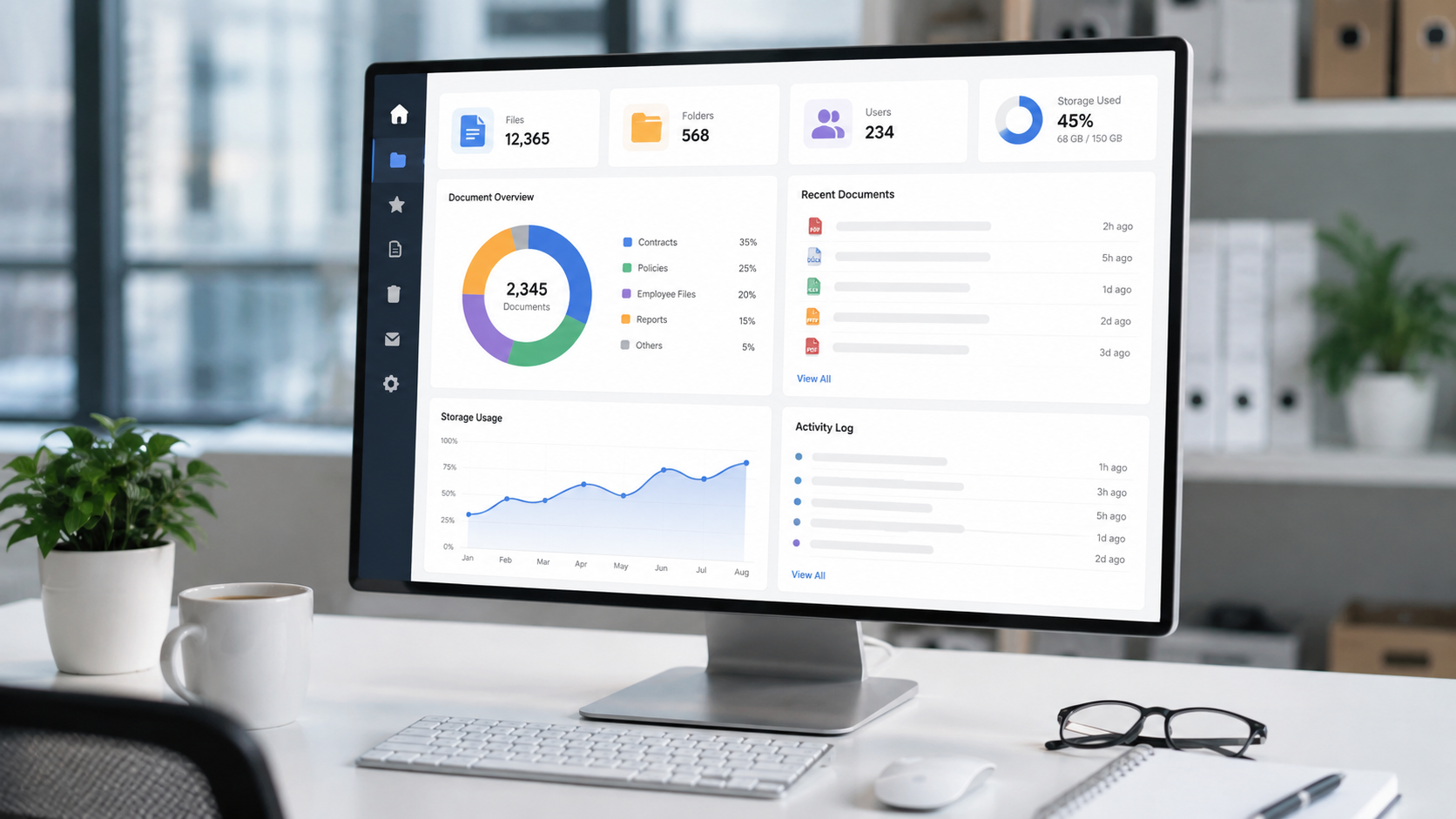
Think of a DMS as a smart, searchable, secure digital filing cabinet. Instead of physical folders and shared drives, all HR documents are stored in one place, organised automatically, and accessible from any device by the right people.
In an HR context, this covers:
- Offer letters, appointment letters, and NDA agreements
- Monthly salary slips, Form 16, and TDS certificates
- PF forms, ESI challans, PT returns, and labour law registers
- Appraisal forms, promotion letters, and warning letters
- Resignation letters, relieving letters, and full and final settlement records
- Training certificates and Learning Management Software completion records
When a DMS sits inside an AI-powered HRMS like Voyon Folks, documents are not just stored. They are connected to employee profiles, triggered by workflow events, and tracked for expiry automatically.
The 10 Benefits, From Basic to Advanced
1. Eliminate Physical Paperwork and Storage Costs
The most immediately visible change when HR goes digital.
A company with 300 employees typically maintains 4 to 6 physical filing cabinets and pays staff time to manage them. The IT Act 2000 and Companies Act 2013 permit digital records to be legally valid for most HR documents, so there is no legal reason to maintain physical copies.
What this saves: INR 40,000 to INR 1.5 lakh per year in filing costs, storage space, and paper for a 200 to 500 person organisation. A DMS pays for itself within 6 to 12 months through this benefit alone.
2. Find Any Document in Seconds
Instead of opening folders manually, HR staff type an employee name, document type, or keyword into the search bar. The document appears instantly.
- A PF withdrawal query that currently takes 30 minutes of searching takes under 60 seconds in a DMS
- A 5-person HR team handling 50 document requests per week recovers 8 to 10 person-hours every single week
- That is the equivalent of adding a part-time resource at zero additional cost
3. Statutory Compliance Without Last-Minute Panic
This is where document mismanagement costs real money in India.
Indian businesses are governed by the EPF and Miscellaneous Provisions Act 1952, the ESI Act 1948, the Payment of Gratuity Act 1972, the Factories Act 1948, and state-level Shops and Establishments Acts. Each carries record-keeping obligations with financial penalties for non-compliance.
A DMS sends automated alerts when:
- A PF challan filing deadline is approaching
- An employee contract is up for renewal
- A statutory register needs to be updated
The EPF Organisation levies penalties of 5 percent per month on delayed contributions. An automated DMS with compliance alerts reduces missed filings to near zero and eliminates these avoidable penalties.
4. The Right People See the Right Documents
A DMS allows HR administrators to set role-based permissions. A payroll manager can access salary records but not appraisal documents. A department head can view their team's contracts but not another team's personal data. An auditor gets temporary read-only access and loses it automatically after the audit ends.
This is not just good practice. India's Digital Personal Data Protection Act 2023 (DPDPA) establishes binding obligations on how employee personal data is stored and accessed. HR departments without access controls are directly exposed to DPDPA compliance risk.
5. Version Control: Always Know Which Document Is the Latest
When a document is updated, the DMS keeps the previous version and clearly marks the current one. You can see who made changes, when, and exactly what was different. Employment contracts, HR policies, and salary structures get updated regularly during appraisal cycles, after regulatory changes, or when company policies evolve. Without version control, employees and managers often work from different versions of the same document, creating disputes around notice periods, leave policies, and variable pay terms. During a labour court case or employee dispute, being able to produce the exact contract version the employee signed on their exact joining date is legally significant.
6. Faster Onboarding Through Automated Document Workflows
When a new employee is added to the HRMS, the DMS triggers an automatic checklist: offer letter issued, appointment letter signed, ID proof uploaded, bank details submitted, PF nomination form filled. HR does not need to chase manually.
- The average Indian SME takes 3 to 7 working days to complete new employee documentation
- Companies with monthly joining batches of 10 to 30 employees face a significant admin backlog every month
- An automated document workflow cuts this to 1 to 2 days and ensures nothing is missed
Faster documentation means employees are on payroll sooner and PF accounts open on time.
7. Training Records Connected to Learning Management Software
When a DMS integrates with Learning Management Software (LMS), training certificates and course completion records are automatically stored against each employee's profile. HR does not collect and file these manually.
This matters most for mandatory compliance training. The POSH Act 2013 (Sexual Harassment of Women at Workplace) requires documented training records that must be produced during Internal Complaints Committee investigations or government inspections. Similarly, fire safety, first aid, and sector-specific compliance training carry documentation requirements in manufacturing and healthcare.
An integrated DMS and LMS means that when an auditor asks for proof of mandatory training, HR produces a full timestamped record for every employee in minutes, not days.
8. Remote Access: Managing HR Documents From Any City
A cloud-based DMS means HR teams, employees, and managers can access relevant documents from any device, from any location in India, without being physically present in the office.
Indian companies with offices across multiple cities, distributed factory sites, or work-from-home employees face a genuine document access problem. A factory HR manager in Ahmedabad cannot easily access records maintained at the Mumbai head office. A remote employee in Bengaluru cannot physically submit onboarding documents.
Employee Self-Service portals within modern HRMS platforms let employees upload documents, download payslips, and access policies from their mobile phones without HR acting as intermediary. This eliminates a significant volume of daily administrative queries.
9. Audit-Ready at Any Time, Not Just Before an Audit
A DMS maintains a continuous audit trail of every document: who created it, when it was uploaded, who viewed it, when it was edited, and when it was shared. This log is tamper-proof and available on demand.
Labour inspectors under the Factories Act, EPF inspectors, and income tax officers can conduct unannounced visits requiring immediate production of employment registers, wage records, PF challans, and ESI contributions. Several Indian states have moved to online inspection systems, making digital document readiness a practical requirement, not just good practice.
With a DMS, responding to an unannounced inspection becomes a 10-minute exercise of running a report and sharing access, rather than a 3-day emergency of locating physical files.
10. Document Intelligence for Smarter HR Decisions
This is where a DMS moves from an operational tool to a strategic asset.
An AI-powered HRMS with integrated document management does not just store documents. It extracts data from them. Joining dates from appointment letters, salary figures from offer letters, skill data from training certificates, and contract renewal dates all feed into HR analytics automatically, without manual data entry.
Voyon Folks HRMS uses document intelligence to surface insights such as:
- Which departments have the lowest onboarding document completion rates, correlating with higher early attrition
- Which employees have certifications expiring in the next 90 days, enabling proactive training scheduling
- Which contract renewals are approaching across the workforce, enabling retention conversations before employees start looking elsewhere
This is the benefit that separates companies running HR on data from companies running HR on instinct.
Conclusion: Paperwork Was Never an HR Strategy
The reason most Indian HR teams are buried in documents is not that HR work is inherently administrative. It is that the tools built around HR were never designed to eliminate the administration. A Document Management System does not make paperwork faster. It removes the need for most of the manual document handling that currently defines the working day of HR professionals across India. Start with the immediate wins: time saved, storage costs eliminated, compliance deadlines automated. Build toward the strategic layer: version control, audit readiness, and document intelligence that feeds real HR decisions.
For Indian companies at any stage, from a 30-person startup in Hyderabad to a 2,000-person manufacturer in Gujarat, a modern DMS integrated with HR software is no longer an upgrade. It is the operational baseline.
Voyon Folks HRMS includes native document management with India-specific compliance templates, automated workflows, and full integration with payroll, attendance, and Learning Management Software. Learn more at voyonfolks.com.
FAQs
Is a DMS legally required for HR in India?
The DMS itself is not mandated by name, but the record-keeping obligations it fulfils are. The EPF Act requires wage records for 5 years. The Factories Act mandates specific registers. The POSH Act requires documented training and complaint records. A DMS is the only practical way to meet these obligations reliably.
How is a DMS different from Google Drive?
Google Drive stores files. A DMS enforces role-based access, maintains automatic version history, generates audit trails for every document action, sends compliance expiry alerts, and triggers document workflows based on HRMS events like joining or resignation. Shared drives create security risk and audit liability that a proper DMS eliminates.
How long does implementation take in India?
A cloud-based HRMS with built-in DMS takes 2 to 6 weeks depending on company size and data migration scope. A 50-person company can go live in 2 weeks. A 500-person company with physical records to digitise typically takes 4 to 8 weeks.
How does a DMS connect with Learning Management Software?
When DMS and LMS share the same HRMS platform, a training completion in the LMS automatically creates a certificate record in the DMS linked to the employee's profile. Mandatory training deadlines appear in the same compliance calendar as statutory filing deadlines, with no manual filing required.
About the Author:
This article is written by an HRMS professional with over 4 years of experience in payroll systems, HR technology consulting, and implementation support across India and the GCC. Regulatory references reflect the framework in effect as of 2026.