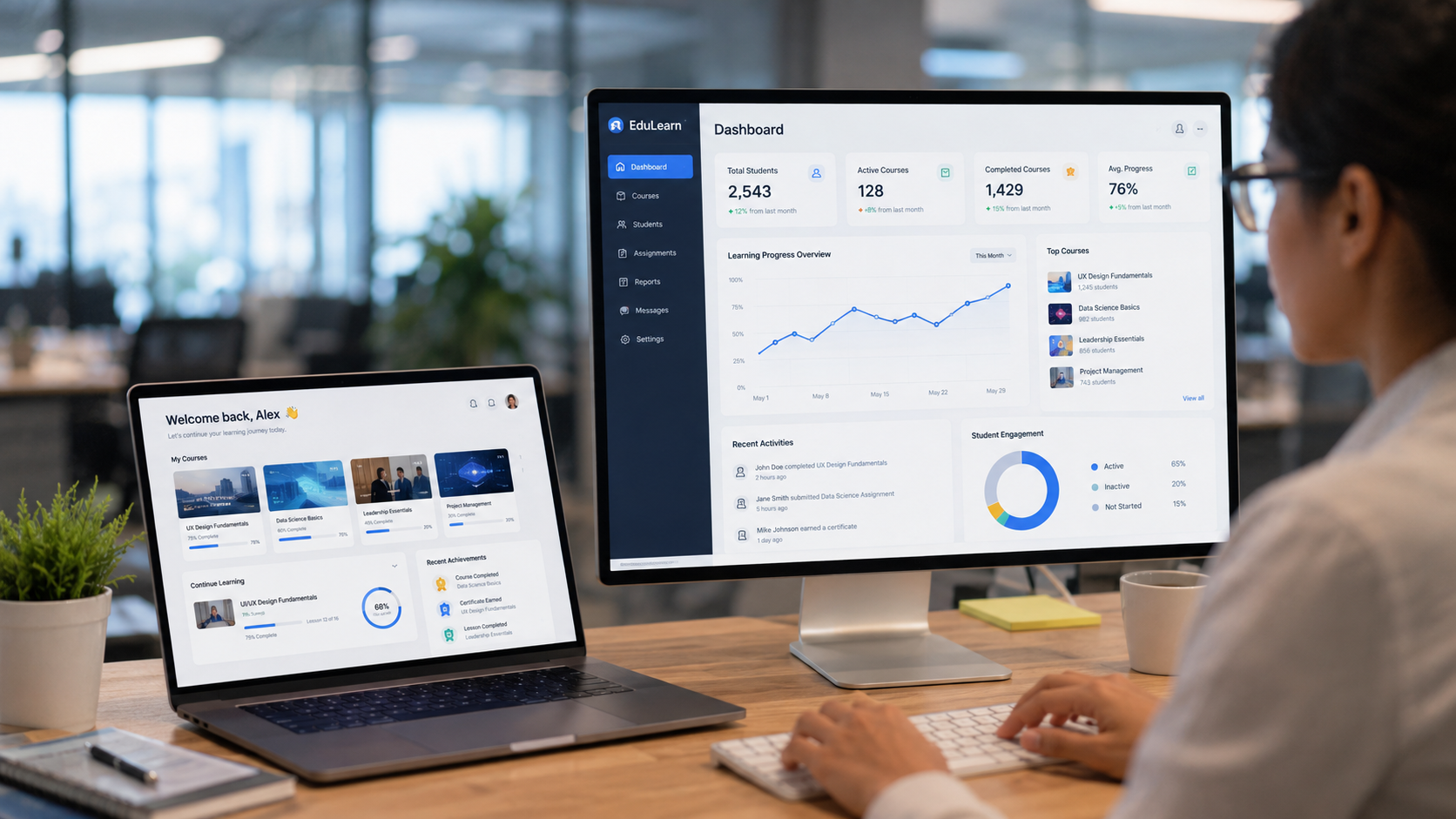
Every business that is still relying on PDF guides, classroom training, and emails to train their employees is already behind the curve. India's IT, manufacturing, healthcare, and retail sectors are undergoing a digital transformation that prioritizes time, money, and employee progress. If you are an Indian business owner looking to implement a learning management system, this article is your guide to understanding the software's capabilities and choosing the most suitable learning management software.
We will discuss what is learning management software and why it is important to Indian businesses, how does it work, who uses it, what are the best features, how it fits with your broader HR technology stack, and compare top vendors' offerings.
What Is Learning Management Software and Why Is It Important?
Learning management software is a digital platform that enables organizations to design, deliver, manage, and track employee training more effectively. Training content, progress, assessments, and certifications that would have been previously managed through email and physical paperwork, are digitized and centralized in a learning management system (LMS).
This level of convenience is extremely important for Indian businesses as the World Economic Forum estimates that 44% of skills relevant to the Indian workforce are likely to change in the next five years. In addition to being a strategic advantage over competitors that are slow to adapt, an LMS enables organizations to create a more consistent and trackable approach to training. For example, as an LMS connects with the business's human resource management system (HRMS), employee records in the HRMS can be automatically updated when a learner completes a course.
How Does It Work: The Absolute Beginner's Guide
Suppose you are an Indian business owner that has no prior experience with learning management software. Here is a list of the most important features explained in simple terms:
Step 1: Create or upload training content
In your LMS, your learning and development team will be able to design and upload courses or training material.
Step 2: Assign the relevant courses
Based on role, department, region, or other criteria, relevant training will be automatically assigned to employees.
Step 3: Complete assigned training
Employees can access the LMS from any device and complete the assigned courses.
Step 4: Automatically tracked progress
From the LMS dashboard, managers will be able to monitor and manage trainee progress.
Step 5: Certifications issued
At the end of a course, a certificate will be issued and tracked within the LMS.
Step 6: Reporting and analytics
Training progress and skill development will be visible to business leaders within the reporting dashboard.
Who Uses Learning Management Software and Why?
When you think about who uses learning management software, it might seem like these are only relevant to large organizations with dedicated L&D departments. An LMS can be used by all types of Indian businesses:
- IT and tech: To train employees on technical skills and offer product knowledge courses to resellers and customers
- Manufacturing: To train workers on machinery operation manuals and safety procedures
- Healthcare: To comply with regulatory and accreditation requirements
- Retail: To offer standardized training to thousands of employees
- BFSI: To ensure employees are up-to-date with compliance and risk management certifications
Key Features of Learning Management Software Relevant to
Indian Businesses
Not every feature you see on an LMS vendor's website is relevant to your business. Below are the most important features to consider:
Mobile-first design
india has more mobile phone users than PC users among the workforce, so the LMS needs to be optimized for phones.
Multilingual support
if your workforce is distributed across Hindi, Telugu, Tamil, Bengali, or other language-speaking regions, the software needs to support localized language content.
Automation of training enrollment and reminders
An LMS should be able to enroll employees in relevant courses as soon as they join the organization or remind them to renew expired certifications.
Native integration with your existing HRMS and attendance management system
To minimize administrative workload, your LMS should intuitively sync with your existing HR technology stack.
Assessment and certification functionality
Your LMS should be able to assess employees' performance in a course or test their skills through skill assessments, quizzes, and other formats.
Reporting and analytics
Managers and business owners need an oversight of the entire training operation to maximize ROI. This is best achieved through intuitive reports and dashboards that indicate progress, completion rates, and skill development trends.
Content authoring tools
Your L&D team should be able to create and edit training material without requiring technical expertise. Some LMS products offer a course builder that does not require coding.
AI-powered recommendation engine
Advanced LMS products use artificial intelligence to suggest relevant courses to employees based on their roles, performance, and skill gaps.
How LMS Connects with Your Broader HR Technology Stack
Many Indian businesses that think they are ready for an LMS overlook one critical detail: how an LMS links with the rest of their technology infrastructure. An LMS that is not native to your organization can create data silos. An efficient learning management software should intuitively sync with your existing systems. This means when leave applications in your attendance management system are marked as approved or rejected, the LMS will not schedule training for employees on leave. When a new candidate accepts the job offer in your HRMS software, the onboarding course in the LMS is automatically enrolled.
Below are a few examples:
Attendance management system
Integration with an attendance management system will ensure that no training is scheduled when an employee is on a break.
HRMS system
Syncing with the human resource management system will enable the LMS to recognize new hires and update employee records in the HRMS when a certification is completed.
Performance management system
Integration with a performance management system means that the LMS will be able to recommend relevant skills courses to employees based on performance reviews.
Voyon Folks HRMS learning management software connects with your HRMS, attendance, and payroll systems by design. There is no need to manage separate systems because an LMS is embedded directly into the Voyon Folks platform. Learn more at www.voyonfolks.com.
Comparing Top Learning Management Software in India 2026
When evaluating learning management software, it is important to understand which solutions are most suitable for your business. Below is a brief overview of the top 6 LMS vendors in India.
VoyonFolks LMS
Best For: Indian businesses that want to have learning management capabilities embedded directly in their existing HRMS. Eliminate the need to maintain multiple separate systems by using an all-in-one solution.
Key benefits:
- Native to Voyon Folks HRMS platform: Payroll, attendance, performance, and learning management are connected
- Easy to use: No coding skills are necessary to manage courses and employees
- Scalable: Suitable for 1,000+ employee organizations
- Ideal for Indian multinationals: With a presence across India, UAE, and Southeast Asia, Voyon Folks understands the needs of Indian business owners
Pricing: Learning management software is available as part of the Voyon Folks HRMS subscription. Contact sales for enterprise pricing.
MapleLMS
Best For: Enterprises and associations that want an intelligent learning platform with AI-powered recommendation engine and analytics.
Key benefits:
- Native to Salesforce: Can be used by Salesforce administrators
- High scalability: Suitable for associations with up to 2,000,000 users
- Course marketplace: Build and sell courses with native e-commerce functionality
- AI-powered: Offers personalized learning recommendations based on employees' performance and behaviors
Pricing: Contact sales for enterprise pricing. Overall, the LMS is positioned as a mid-market and enterprise solution with costs that fall in the high range for Indian businesses. A free trial is available.
Docebo
Best For: Enterprises with international workforces that want to offer AI-powered, personalized online learning experiences.
Key benefits:
- AI-powered: Offers personalized learning recommendations
- Easy to use: Designed for non-technical super-users and administrators
- Analytics: Detailed performance reports and dashboards available for managers and business owners
- High-end design: Offers polished user experience
Pricing: Contact sales for enterprise-level pricing. Docebo is positioned as a premium provider: the entry-level plan starts at INR 3,00,000 per year for Indian businesses.
TalentLMS
Best For: Growing businesses and small and medium-sized businesses (SMBs) that want to onboard employees faster while minimizing training costs.
Key benefits:
- No coding: Easy to set up and use
- Fast onboarding: Choose from pre-designed courses to get started
- Intuitive interface: Employees will spend less time trying to understand how the LMS works
- Affordable pricing: Pay less for faster onboarding and productivity gains
Pricing: TalentLMS starts at INR 1,500 to INR 2,000 per user per month. Pricing is lower for annual commitments. A free plan is available for up to 5 users and 10 courses to try before you buy.
Cornerstone OnDemand
Best For: Large enterprises that want to invest in a comprehensive talent management solution that includes learning, performance, and workforce analytics.
Key benefits:
- End-to-end solution: Manages performance, compensation, and learning
- Scalability: Suitable for enterprises with thousands of employees
- Analytics: Advanced reporting and actionable insights are available for managers
- Personalized learning: Artificial intelligence recommends relevant courses based on employees' performance
Pricing: Contact sales for enterprise-level pricing. Cornerstone OnDemand is designed for large businesses and operates at the higher end of the price spectrum. The software needs to be evaluated on a yearly cost basis.
GreytHR LMS
Best For: Indian businesses that want to add learning management capabilities to their existing GreytHR software stack.
Key benefits:
- Native to GreytHR: No coding or technical expertise is necessary
- Scalability: Suitable for organizations of all sizes
- Comprehensive features: Attendance, payroll, performance, and learning management are available in one software
- Easy to use: Familiar interface reduces the learning curve
Pricing: Can be added as an extension to GreytHR subscriptions. Annual pricing is available per employee. Contact sales for details on pricing in India.
The One Question You Should Ask Before Buying Learning Management Software in India
Before you start comparing learning management software features, answer this one simple question: do you want a standalone learning platform that will have to be connected to your existing HR software with an expensive and time-consuming integration project or a learning management software that intuitively fits with your existing HR technology stack?
Best Practices for Successfully Adopting
Learning Management Software
Below are the most common best practices for successfully adopting learning management software.
Set specific objectives
Before you configure your LMS or begin working with an implementation partner, set specific objectives. Define what you want to measure: is it the percentage of employees who complete compliance training, or is it the time it takes for new hires to become productive? Setting objectives will help you choose the most relevant features and get the most out of your LMS.
Designate a pilot group
Do not roll out the LMS to your entire organization at once. Choose a pilot group and configure the LMS based on their feedback.
Make sure your content is mobile-friendly
If you are using PowerPoint or Word documents to design your courses, you will have to rework them for a mobile-first LMS. Design your most important courses with mobile in mind.
Identify internal training champions
Find a few enthusiastic managers in different departments who can encourage their teams to use the LMS and offer support. The support of a single experienced trainer can be more valuable than any marketing campaign.
Connect training completion to business outcomes
If your employees complete training courses, make sure it reflects positively on their performance reviews. Encourage managers to recognize employees who achieve certifications within the LMS. By tying training to career outcomes, you provide additional motivation beyond compliance.
Frequently Asked Questions About Learning Management Software
1. What is learning management software in simple terms?
Learning management software is a digital platform that your business uses to organize employee training. Instead of conducting and documenting training in emails or physical files, an LMS digitizes the process, making it easier to monitor and track.
2. How is learning management software different from a video library?
An LMS is much more than a video library. While a video library will host your training content, an LMS will ensure that the right people watch the videos and verify that they understood the material. A video library does not offer compliance, quizzes, or tracking capabilities.
3. How does learning management software connect with HRMS software?
When connected to your organization's HRMS, an LMS can automatically assign courses to newly hired employees or pause training for employees who go on leave. By connecting the LMS and HRMS, you get a comprehensive view of the employee's performance, attendance, and training history.
4. Is learning management software suitable for small businesses?
Learning management software can be used by organizations of all sizes. While large enterprises will benefit from advanced features such as analytics and artificial intelligence, small businesses will find that an LMS helps them standardize and track their training practices. Most LMS vendors offer affordable pricing plans for small businesses. Choose an LMS that offers a free plan or a low-cost plan for 1,000+ employees if you are just getting started.
5. How long does it take to implement learning management software for an
Indian business with 300 employees?
For an Indian business with 300 employees, the implementation timeline can vary depending on a few factors. If you already have training materials and a clean employee database, it should take 6 to 10 weeks to implement the LMS and begin delivering the first batch of courses. If you need to create training materials from scratch, you should add another 4 to 8 weeks to the timeline. If your organization uses an existing HRMS software, you should add another 2 to 3 weeks to configure the LMS.
6. What is the most important factor to consider when choosing learning management software?
When choosing learning management software, focus on solutions that intuitively connect with the rest of your technology stack. Many Indian businesses overlook the importance of a seamless connection between the LMS and the organization's existing systems. If a standalone LMS is right for your organization, prioritize solutions that offer better native compatibility with your existing technology stack.
ABOUT THE AUTHOR
This article was written by an HRMS professional with over 4 years of experience in payroll, consulting, and implementation.