Strategic Introduction: Why Payroll Is a Board-Level Risk in Malaysia
In Malaysia, payroll compliance is not an HR detail. It is a balance-sheet exposure. EPF, SOCSO, and EIS obligations are statutory liabilities that sit directly between payroll execution and legal accountability. When payroll fails, the consequences escalate beyond HR into finance, audit committees, and directors’ personal exposure. Many organisations still treat payroll as a monthly routine handled by staff who “know the rules.” That assumption breaks the moment headcount grows, salary structures diversify, or enforcement tightens. Malaysian authorities do not accept intent as a defence. They assess accuracy, timeliness, and record integrity.
This is why payroll software in Malaysia has shifted from operational convenience to governance infrastructure. A modern HRIS system in Malaysia must not only calculate salaries but enforce statutory logic, preserve evidence, and surface risk early. Manual systems cannot do this consistently. Voyon Folks HRMS addresses this problem at the system level by embedding payroll compliance into automated workflows, reducing dependency on memory, spreadsheets, and last-minute corrections. The goal is not speed alone. It is control. More details are available at www.voyonfolks.com.
Business Context and Definition: Payroll Compliance in the Malaysian Operating Environment
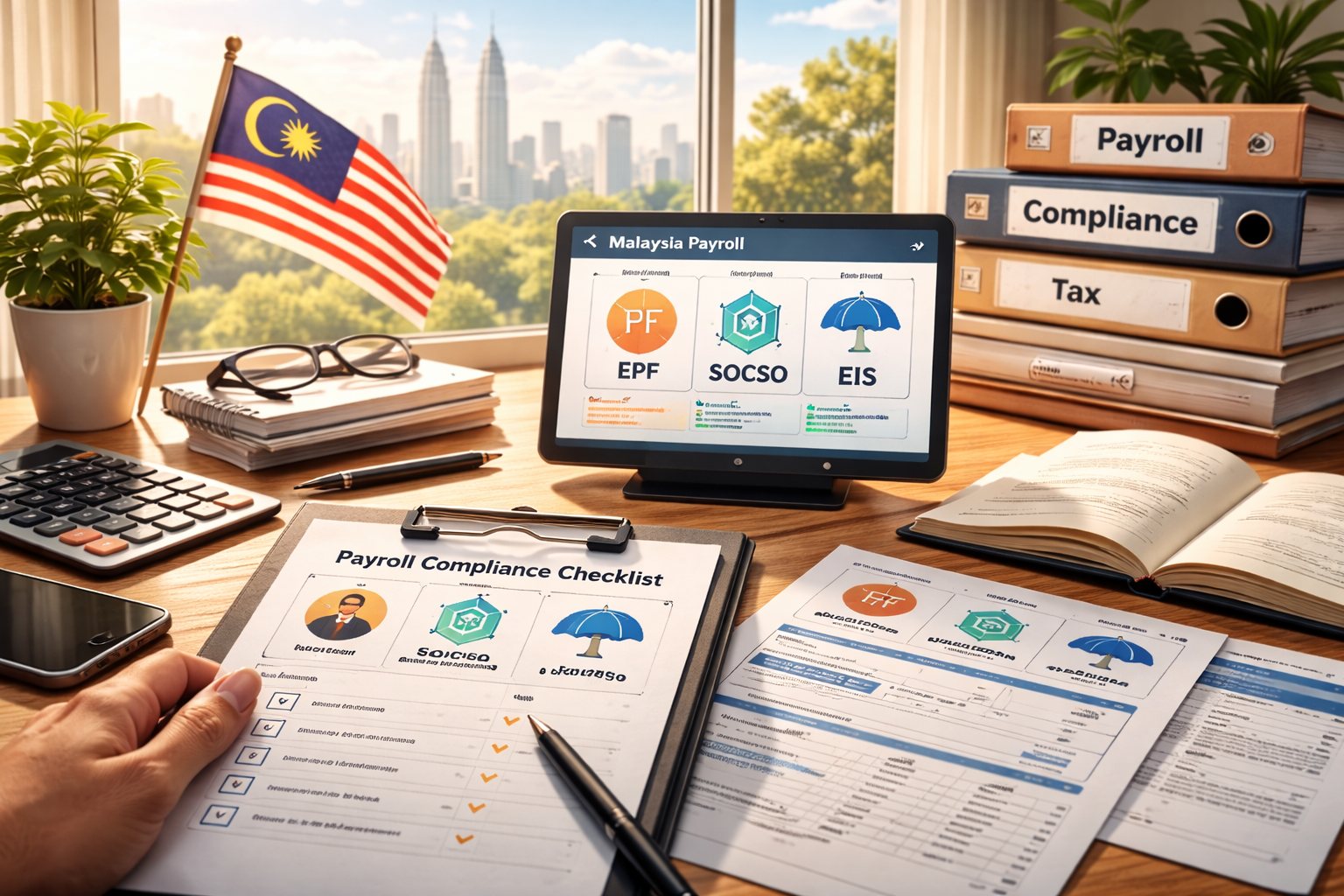
Malaysia operates under a clearly defined payroll compliance structure, but clarity does not equal simplicity. Employers must simultaneously comply with the Employees Provident Fund Act 1991, the Employees’ Social Security Act 1969, and the Employment Insurance System Act 2017. Each statute governs a different contribution scheme, administered by different authorities, with different penalties. An HRIS system in Malaysia must therefore function as a compliance engine, not a payroll calculator. EPF focuses on retirement savings and contribution integrity. SOCSO addresses employment injury and invalidity protection. EIS supports income security during unemployment. Each scheme has unique thresholds, eligibility conditions, and reporting expectations.
Market conditions make this more complex. Malaysia’s workforce is increasingly hybrid. Companies operate across Selangor, Kuala Lumpur, Penang, and Johor simultaneously. Wage structures now include allowances, variable pay, and shift-based earnings that directly affect contribution accuracy. In this environment, payroll software in Malaysia must integrate attendance, salary components, and statutory rules into a single, auditable system. A disconnected labor management system creates reconciliation risk. A unified HRMS system Malaysia businesses can trust becomes a compliance safeguard rather than an administrative tool.
The Cost of Inaction: What Happens When Payroll Compliance Breaks
The financial cost of payroll non-compliance in Malaysia is explicit. Under the Employees Provident Fund Act 1991, failure to remit EPF contributions can result in fines up to RM10,000 or imprisonment up to three years. Where employee deductions are withheld but not paid, penalties escalate to RM20,000 or imprisonment up to six years. SOCSO enforcement adds another layer. Employers who fail to register employees, submit contribution schedules, or maintain proper records can face compounds ranging from hundreds to thousands of ringgit, with prosecution possible for repeated or serious breaches.
For CFOs and CEOs, the indirect costs are often larger:
- Cash flow disruption from retrospective payments and penalties
- Audit delays caused by missing or inconsistent payroll records
- Management time lost to investigations and corrective filings
- Reputational damage during due diligence or funding rounds
Manual Payroll vs Payroll Software in Malaysia
Manual processes rely on individual competence and continuity. Software relies on enforced logic. Manual payroll breaks when staff change, rules update, or volume increases. Payroll software in Malaysia embeds statutory rates, deadlines, and validation rules into the system itself. This removes single points of failure and converts compliance into a repeatable process. Choosing not to modernise payroll is not cost-neutral. It is a decision to accept unmanaged risk.
Key Solution Focus: Automation as Compliance Control
Automation in payroll is not about replacing people. It is about replacing uncertainty.
A robust HRMS system Malaysia organisations deploy must automate statutory calculations, validate inputs, and flag anomalies before payroll is finalised. Voyon Folks HRMS applies this principle by integrating payroll, attendance, and statutory compliance into one workflow. EPF contributions are calculated based on defined salary components and age criteria. SOCSO contributions are applied according to category and wage ceiling. EIS deductions are computed separately, ensuring correct reporting. These are not post-processing steps. They are embedded at the calculation stage.
Consider a mid-sized services firm in Kuala Lumpur with 250 employees and variable allowances. Manual payroll requires repeated checks every month. With payroll software in Malaysia, the system enforces rules consistently, regardless of who runs payroll. Automation also creates traceability. Every change is logged. Every payroll run is stored. When auditors ask, data is produced, not reconstructed. That is the difference between operational software and governance infrastructure.
Scalability and Adaptability: Payroll That Grows Without Breaking
Growth exposes weak systems. Payroll is no exception. As Malaysian companies scale, they add locations, employee categories, and employment arrangements. A payroll setup that works for 30 employees collapses at 300 if it relies on manual intervention.
An HRIS system in Malaysia must support:
- Multi-location payroll with consistent statutory logic
- Hybrid and remote workforce attendance integration
- Salary structure changes without historical data loss
Payroll software in Malaysia also plays a role in data protection. Salary and statutory records are sensitive. Storing them in spreadsheets or email threads increases exposure. Centralised HRMS platforms use role-based access and audit logs to reduce internal risk. Scalability is not about handling more employees. It is about handling complexity without multiplying errors.
Regional and Industry-Specific Realities in Malaysia
Payroll compliance pressure varies by industry.
Manufacturing firms in Selangor and Penang face overtime-heavy payrolls where attendance accuracy directly impacts EPF and SOCSO calculations. Logistics companies in Johor manage shift rotations and variable allowances. Technology firms in Kuala Lumpur handle hybrid workforces with flexible pay structures. These differences matter because statutory contributions are wage-based. Misclassification or inconsistent attendance feeds incorrect payroll data into compliance calculations.
A labor management system that integrates time, attendance, and payroll is essential in these environments. Payroll software in Malaysia must reflect how people actually work, not how policy documents describe work. Generic payroll tools fail here. HRMS system Malaysia solutions designed for local industries maintain accuracy even as operating models differ.
Compliance and Statutory Alignment
Malaysian payroll compliance rests on named legislation with enforceable penalties.
The Employees Provident Fund Act 1991 governs EPF contributions and remittance deadlines. The Employees’ Social Security Act 1969 regulates SOCSO coverage and contributions. The Employment Insurance System Act 2017 mandates EIS deductions. Failure under these laws results in fines, imprisonment, or both. There is no grace period based on company size or intent.
HRMS platforms address this by embedding statutory rules into payroll logic. When contribution rates change, systems update centrally. When deadlines approach, workflows enforce cut-offs. Compliance is not achieved by effort. It is achieved by design.
Competitive Advantage and Market Positioning
Companies with strong payroll systems operate with confidence. They close books faster. They pass audits cleanly. They expand without rebuilding core processes. Companies without them accumulate risk quietly until an inspection, acquisition, or dispute exposes weaknesses. Early adoption of payroll software in Malaysia positions HRMS as long-term infrastructure. Delay increases migration cost, data cleanup effort, and exposure. This is not about keeping up with competitors. It is about avoiding preventable failure.
ROI and Executive Justification
The ROI case for payroll software in Malaysia is rooted in risk reduction. Avoiding a single EPF breach can save tens of thousands of ringgit in fines and remediation. Reducing payroll processing time by even 30 percent frees HR and finance resources for higher-value work.
Productivity gains come from fewer corrections, fewer disputes, and fewer audit interventions. Compliance cost avoidance often delivers payback within the first year, especially for companies above 100 employees. For executives, the real ROI is predictability. Predictable payroll means predictable cash flow, predictable compliance, and predictable governance outcomes.
Strong Conclusion: Payroll Compliance Is Not Optional Infrastructure
Malaysia’s payroll framework is mature, enforced, and unforgiving. EPF, SOCSO, and EIS are not theoretical obligations. They are monthly tests of operational discipline. Organisations that rely on manual processes are not saving money. They are deferring risk. Eventually, that risk materialises as penalties, audits, or reputational damage.
Payroll software in Malaysia and a reliable HRIS system in Malaysia are no longer discretionary tools. They are foundational systems that protect leadership, finance, and the organisation itself. Voyon Folks HRMS positions payroll as controlled infrastructure rather than administrative effort. The next step for decision-makers is not learning more rules. It is deciding whether their current systems can enforce those rules consistently, every month, without exception.
FAQs
1. Why is payroll software in Malaysia critical for compliance, not just efficiency?
Payroll software in Malaysia enforces statutory logic automatically. EPF, SOCSO, and EIS rules are applied consistently regardless of staff changes or payroll volume. Manual systems depend on human accuracy, which degrades over time. Compliance failures carry fines and imprisonment risk, making automation a governance necessity rather than an efficiency upgrade.
2. How does an HRIS system in Malaysia reduce EPF risk?
An HRIS system in Malaysia links employee data, salary components, and statutory contribution rules into one system. This prevents underpayment, late remittance, and record gaps. EPF inspections focus on accuracy and documentation. A systemised payroll trail significantly reduces exposure during audits.
3. Can payroll software handle SOCSO and EIS simultaneously?
Yes, but only if designed correctly. SOCSO and EIS are governed by separate laws with different contribution logic. Payroll software in Malaysia must calculate and report them independently. Systems that bundle deductions loosely increase reporting errors and compliance risk.
4. What risks do CFOs underestimate in manual payroll?
CFOs often focus on penalties but underestimate audit disruption, leadership time loss, and reputational damage. Manual payroll also increases dependency risk. When one experienced payroll staff member leaves, institutional knowledge leaves with them. Software institutionalises compliance.
5. How long does HRMS implementation typically take in Malaysia?
For mid-sized organisations, implementation usually spans several weeks, including parallel payroll runs. The real risk is not duration but data quality. Clean employee and payroll data is essential. A structured implementation reduces long-term compliance exposure.
6. What should executives evaluate when choosing a payroll system?
Executives should assess statutory coverage, audit trail quality, scalability, and local compliance expertise. A strong HRMS system Malaysia businesses choose should explain how it enforces EPF, SOCSO, and EIS rules, not just how it runs payroll screens.
About the Author
The author is an HR technology and workforce operations specialist with extensive experience advising UAE-based companies on HRMS implementation, payroll compliance, and labor law alignment. Their work focuses on bridging operational execution with regulatory governance across high-growth environments.